Hello, I never entirely solved the problem of auto-placing orders in WL8 and have moved to WL9. Previously, the problem was that my designed algorithms connecting to Interactive Brokers did not generate signals that matched the backtest runs.
However, in WL8, the backtest at least generated a little chime indicating that a position would be open. I notice in WL9 there is no such chime. I have loaded about 75 algorithms into the auto-place and, perhaps not surprisingly, have found when implementing them that none of them generated any trade signals, even though the backtest clearly shows many should be in active positions.
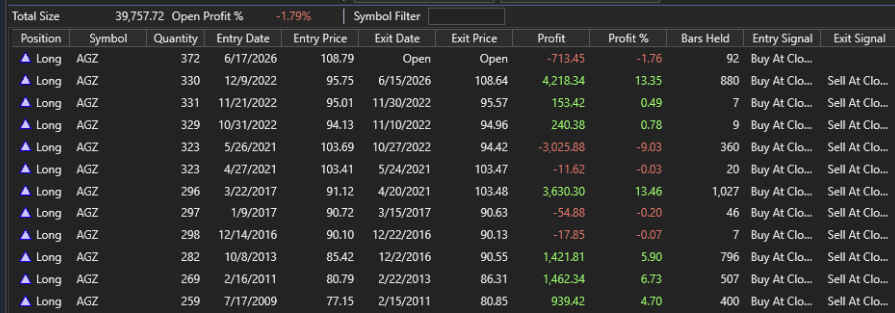
For example, here is a backtest position showing an active position. (And no chime.)
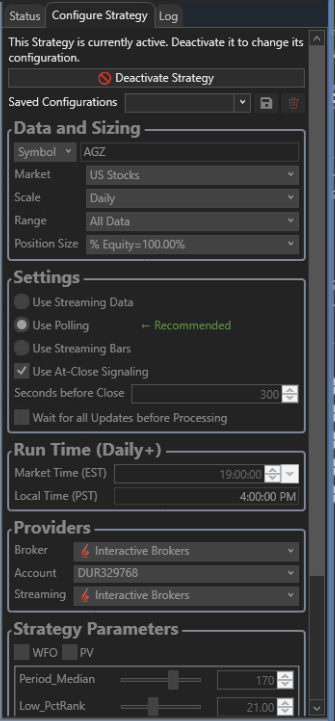
Here is the activated algorithm's main settings.
The log from yesterday's run shows 0 signals. It might be that there are some simple steps initially to troubleshoot. Obviously, with 75+ algorithms, I can't run these manually and must rely on auto-place to implement them faithfully.
However, in WL8, the backtest at least generated a little chime indicating that a position would be open. I notice in WL9 there is no such chime. I have loaded about 75 algorithms into the auto-place and, perhaps not surprisingly, have found when implementing them that none of them generated any trade signals, even though the backtest clearly shows many should be in active positions.
For example, here is a backtest position showing an active position. (And no chime.)
Here is the activated algorithm's main settings.
The log from yesterday's run shows 0 signals. It might be that there are some simple steps initially to troubleshoot. Obviously, with 75+ algorithms, I can't run these manually and must rely on auto-place to implement them faithfully.
Rename
(the log)
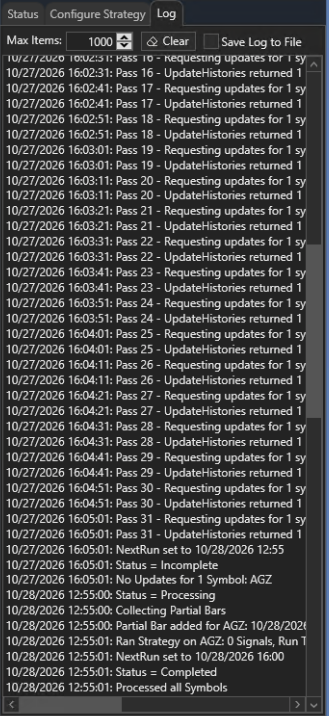
You're trading At Close and it appears your primary historical provider had trouble returning up-to-date data for AGZ. I can't really tell what's going on there because the information is cut off. It's not normal to have more that 1 or 2 passes for the data.
Which checked provider is at the top of the Historical Provider list?
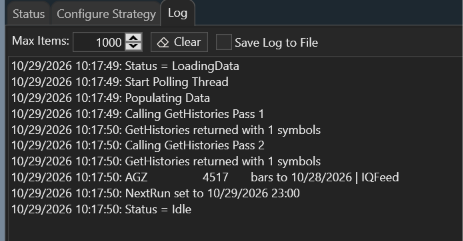
Here my log using your settings.
Which checked provider is at the top of the Historical Provider list?
Here my log using your settings.
It seems the order is WealthData, Yahoo Finance, and then IB.
In WL8 I believe I had set Yahoo Finance and then IB. Would that be preferable?
Also, just a basic nuts and bolts question: when an algorithm starts in medias res (to borrow a literary phrase) and the position should be long based on a previous buy entry order (i. e., with an empty starting position), I assume a long order will be placed, rather than wait a potentially long time until the next long entry signal.
In WL8 I believe I had set Yahoo Finance and then IB. Would that be preferable?
Also, just a basic nuts and bolts question: when an algorithm starts in medias res (to borrow a literary phrase) and the position should be long based on a previous buy entry order (i. e., with an empty starting position), I assume a long order will be placed, rather than wait a potentially long time until the next long entry signal.
Any order for those providers should work fine. I'd probably put IB before Yahoo!, but I just wish we had that full log from the beginning to see how it started (next time you can right click/copy and paste the full log instead of using an image).
Re: nuts and bolts and medias res
If you're describing automatic synchronization of the broker position to the hypothetical, then no - except in the case of the Trading Preference "Exit Orphans Positions at Market", which will only exit a position.
If you want to be in a hypothetical position that you missed for whatever reason, you must do that manually. Then, make sure to pay attention to the Trading preference "Strategies can exit only Linked Positions". Either that should be disabled, or if enabled, you need to Link that manually-added broker position to a Strategy in the Accounts tool.
Hello, that's been a conceptual block for me for some time. It would be nice if there were feature to tick a box to have a position entered automatically if an expected position is missing from the brokerage account. Otherwise, it would take quite some work to initiate initial positions for numerous algorithms; then again, at least it should just be a one-time effort.
A few algorithms did enter new positions but using appreciated account values. The starting value of the backtest might have been $20K, but the current simulated value is now, e. g., $78K and entered that position size. I recall there was some building block or other way to stipulate that the algorithm would start 'now' so that the current simulated value would be set to the desired $20K (or whichever specified starting amount). Can you remind me how to do that? Thanks.
A few algorithms did enter new positions but using appreciated account values. The starting value of the backtest might have been $20K, but the current simulated value is now, e. g., $78K and entered that position size. I recall there was some building block or other way to stipulate that the algorithm would start 'now' so that the current simulated value would be set to the desired $20K (or whichever specified starting amount). Can you remind me how to do that? Thanks.
Can you remind me how to do that?
QUOTE:It is automatic when the strategy creates the position. It's just not possible to do it 'automatically' for positions added manually since there isn't another way to determine with certainty the strategy that created a position from the perspective of a broker account.
if there were feature to tick a box to have a position entered automatically if an expected position is missing from the brokerage account
Great, I will look at those settings.
Let's say I manually start a position for a ticker at $20K. The algorithm is a single-ticker risk on/risk off. When the algorithm says to sell all and go to cash, let’s say (optimistically!) there was some profit and the cash returned is $21K. How can I be certain when the next buy signal occurs that the algorithm will purchase $21K worth of the ticker, so as to remember the original position size?
Even better… if it’s been a while and a bit of interest has accrued on the case, that would be the new entry position, as occurs on the backtest. Thanks.
Let's say I manually start a position for a ticker at $20K. The algorithm is a single-ticker risk on/risk off. When the algorithm says to sell all and go to cash, let’s say (optimistically!) there was some profit and the cash returned is $21K. How can I be certain when the next buy signal occurs that the algorithm will purchase $21K worth of the ticker, so as to remember the original position size?
Even better… if it’s been a while and a bit of interest has accrued on the case, that would be the new entry position, as occurs on the backtest. Thanks.
I don't know what "remember[ing] the original position size" has to do with anything, and, there are innumerable ways you can size positions.
1. Do a backtest.
2. Right click the Equity Curve > Copy Equity Curve Data.
3. Paste it in a spreadsheet
The Equity column is the total value of the hypothetical account and you'll also see the Cash available at the end of each bar. You can use this information to test that the backtest is doing what you expect.
For quicker answers to basic questions like these, click F1 for the User Guide and "Ask AI" in the lower right corner.
1. Do a backtest.
2. Right click the Equity Curve > Copy Equity Curve Data.
3. Paste it in a spreadsheet
The Equity column is the total value of the hypothetical account and you'll also see the Cash available at the end of each bar. You can use this information to test that the backtest is doing what you expect.
For quicker answers to basic questions like these, click F1 for the User Guide and "Ask AI" in the lower right corner.
Thanks, but I'm not really referring to backtesting at this time.
When an active algorithm goes entirely to cash, is there careful accounting of the cash position, so that when the next active position is entered, that exact amount of cash is used to open the position?
When an active algorithm goes entirely to cash, is there careful accounting of the cash position, so that when the next active position is entered, that exact amount of cash is used to open the position?
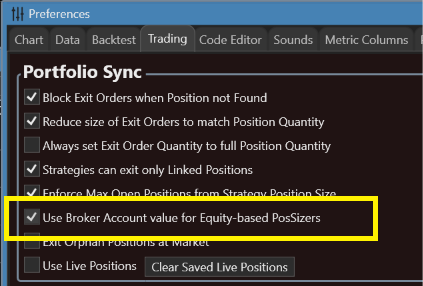
I'll send you back to Post #6. The preference highlighted uses the Broker Account value to feed sizers the real-time equity value (and cash) of the account for sizing the live entry signals.
Exits signals are synchronized with the broker positions with the other preferences - either to reduce size or to always set the quantity to the full Position quantity at the broker.
Exits signals are synchronized with the broker positions with the other preferences - either to reduce size or to always set the quantity to the full Position quantity at the broker.
Your Response
Post
Edit Post
Login is required